
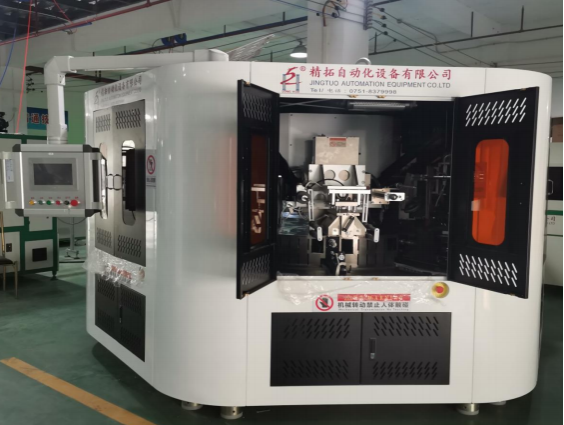
Introduction: The Cost of Specialization
Most printing machines are prisoners of their design. A machine tuned for UV ink struggles with high-temperature processes; a press built for glass might crack plastic. For contract decorators and large brands alike, this means buying multiple machines to handle diverse product lines. Our 6200kg Integrated Screen Printer breaks this mold. It is engineered to be a universal workhorse, seamlessly switching between UV, High-Temperature, and Air-Drying inks across Glass, Plastic, Metal, and Ceramic substrates.
The Three Pillars of Ink Compatibility
The true power of this machine lies in its environmental control systems—electrical, thermal, and UV—all housed within a single 4000x4000mm footprint.
1. UV Ink Printing: The Standard for Speed
UV curing is the backbone of modern high-speed production. Our machine integrates a high-intensity UV Curing System designed for total coverage.
- Process: Prints and immediately exposes the ink to UV light, solidifying it instantly.
- Advantage: Zero Drying Time. Products move directly from the printer to packaging.
- Best For: Cosmetics, daily chemicals, and promotional bottles where scratch resistance and speed are paramount.
- Technical Edge: The 37KW power supply ensures the UV lamps maintain consistent intensity even during rapid cycling (up to 50 pcs/min).
2. High-Temperature Solid Ink: The Standard for Durability
Certain industries (notably automotive and premium spirits) require extreme durability that only high-temperature firing can provide.
- Process: The machine can be equipped with electric heating elements for the screen frame. This keeps the high-temp ink in a fluid state during printing.
- Advantage: Creates a ceramic-like bond that withstands solvents, acids, and abrasion.
- Best For: Glass bottles destined for dishwashers (e.g., beer/wine bottles) or harsh environments.
- Technical Edge: The Unified Jig System ensures the bottle stays cool until printing, preventing premature curing inside the screen.
3. Ordinary Air-Drying Ink: The Standard for Flexibility
Sometimes, simplicity is key. Air-drying inks are essential for specific post-printing processes.
- Process: Printing with standard solvent-based inks.
- Advantage: Ideal for products requiring hot stamping (foil stamping) or secondary processing.
- Best For: Luxury cosmetic packaging where metallic foil effects are added after the base color is laid down.
- Technical Edge: The machine can be equipped with a robotic transfer arm to move wet prints directly into a dedicated oven, saving floor space and manual handling.
Material Mastery: Surface Agnostic Printing
The Full Servo Drive allows for infinite adjustments to squeegee pressure and speed, making it safe for a wide array of materials:
| Material | Common Applications | Printing Consideration | Machine Feature |
|---|---|---|---|
| Glass | Wine bottles, perfume, vials | Fragile, requires smooth handling | Soft-touch servo grippers |
| Plastic | Shampoo, lotion, tubes | Prone to melting/deformation | Adjustable pressure control |
| Metal | Flask caps, aerosol cans | Hard surface, requires adhesion | High-tack UV ink compatibility |
| Ceramic | Premium tableware, tiles | Porous surface | Specialized mesh/squeegee setup |
| Acrylic | Displays, high-end boxes | Scratch sensitive | Dust removal system (pre-print) |
Operational Efficiency: The Integrated Workflow
The magic isn't just in the printing; it's in the elimination of logistics.
- Dust Removal: Every bottle passes through an automatic dust removal device before printing. This is vital for Air-Drying Inks which tend to attract particles.
- Adaptive Fixtures: The same set of fixtures (supporting Ø15-Ø100mm) works across all ink types. Switching from UV to High-Temp ink takes minutes, not hours.
- Automated Unloading: Whether the bottle is hot from a heater, wet from air-dry ink, or cool from UV curing, the robotic unloading system handles it without smudging.
Industry Applications
- Cosmetics: Use UV ink for vibrant colors on plastic, then switch to Air-Dry ink for bases requiring hot foil stamping.
- Spirits: Utilize High-Temp ink for glass bottles that must survive pasteurization and labeling.
- Food Packaging: Use certified Air-Dry inks for safety, with integrated oven transfer for efficient curing.
Conclusion: Future-Proof Your Production Line
Investing in a machine restricted to one ink type is a liability. By choosing a printer that masters UV, High-Temperature, and Air-Drying technologies, you insulate your business against changing market demands and material costs. With a 6200kg stabilized frame supporting these processes, you gain the confidence to take on any job, regardless of the substrate or ink requirement.
Internal Linking Strategy
- [Compare Ink Types: UV vs. High-Temp vs. Air-Dry]
- [Explore the 37KW Servo System]
- [Request a Quote for Multi-Material Printing]